1. what happens to hot lava after it erupts from a volcano?
Abstract
Volcanoes are constantly growing and changing. Every time a volcanic eruption occurs, new rock is added to the surrounding area. These eruptions play a big part in the formation and devastation of rocks likewise as in shaping the Earth's surface. Even so, we do non know everything most the histories of the volcanoes that previously existed on World. Volcanologists—scientists that study volcanoes—tin written report the types of rocks that volcanoes produce, to gain a better understanding of volcanoes. These rocks vary based on the characteristics of the volcano from which they came. Volcanic rocks are unique because nosotros tin study them to accurately discover when and how they were formed. In this article, we explain the processes that make volcanic rocks and formations look different from each other. Nosotros also discuss ways that volcanologists can determine how ancient volcanoes were made, past studying the rocks produced during by eruptions.
Volcanoes and Igneous Rocks
While geologists are scientists who study all kinds of rock, volcanologists are geologists who focus on past and present volcanoes, lava, and magma. Volcanologists too study the rocks that volcanoes make, looking for clues to help them effigy out how and when the volcanoes were formed. By figuring out the conditions that created volcanic rocks, volcanologists tin learn about the history of a volcano and peradventure predict whether a volcano will erupt once again—and what will happen to the landscape and the people living nearby if it does. The rocks surrounding volcanoes give u.s.a. of import information to summate the volcano'due south historic period and to assist us answer questions about how the Earth was formed, including when volcanoes erupted and how explosive the eruptions were [1].
The types of rocks that volcanologists spend their time studying are called igneous rocks. Igneous rocks form when molten rock cools and hardens into solid rock. Molten rock is chosen magma when it is stored in a bedchamber beneath a volcano, but information technology is referred to equally lava when it reaches the surface. Volcanoes are created whenever at that place is a break in the Earth's crust that opens a pathway for magma and gas to escape. Every time a volcano erupts, it changes in shape and size because the lava it releases cools and hardens around it. With fourth dimension, this can make the volcano higher and wider. The largest volcano in the solar system is chosen Tamu Massif, located due east of Japan at the bottom of the Pacific Ocean. While its pinnacle is average, what makes this volcano so large is how far it spans outward. Tamu Massif spans over 553,000 square kilometers, making it larger than the entire country of Spain [2]!
Volcanoes are classified by their shapes and where magma is stored inside them, which both determine how magma tends to be released during eruption. Some volcanic eruptions are vehement, spewing molten rock and gases into the air, while other volcanic eruptions are less explosive simply equally damaging, because lava flows out of the volcano and spreads over big distances. For example, shield volcanoes, similar Tamu Massif, are the main blazon of volcanoes that brand up the Hawaiian Islands. Shield volcanoes have very fluid lava but exercise non have violent eruptions. If lava meets water, nonetheless, the interaction can cause the eruptions to go extremely explosive [3]. The other 3 major volcano types are cinder cones, stratovolcanoes, and lava domes, all of which are much more explosive than shield volcanoes ane , 2 . The large differences in how volcanoes erupt touch on the blazon of lava flows they produce.
Lava Flows
Lava flows in dissimilar ways. Understanding flow types can help volcanologists categorize igneous rocks because features of the rocks change as they cool and harden. Even though lava acts similar a liquid, information technology is constantly cooling as it moves. This makes information technology comport differently depending on its limerick and how quickly it is moving. The type of lava flow depends on the lava's viscosity, or resistance to flow.
The four main types of lava flows are pahoehoe, a'a (pronounced "ah-ah"), blocky, and pillow. Pahoehoe lava (Figure 1a) forms smooth continuous rock, because it is low viscosity and slow moving. A'a lava flows (Figure 1b) occur when lava flows speedily and crumbles at the top and the base, giving it a rubbly appearance. Blocky flows (Effigy 1c) are like a'a flows just happen only with high viscosity lava. Instead of polish stone formations, blocky flows interruption up and create athwart boulders. Blocky flows can attain more than 100 meters in height, like a wave growing outward every bit it travels, before they topple over. Pillow lava (Figure 1d) but occurs underwater. Equally the hot lava flows into the cold h2o, the border of the menses rapidly cools to form volcanic drinking glass, but the within of the catamenia continues to move and pause through the glassy edge, forming a pillow shape.
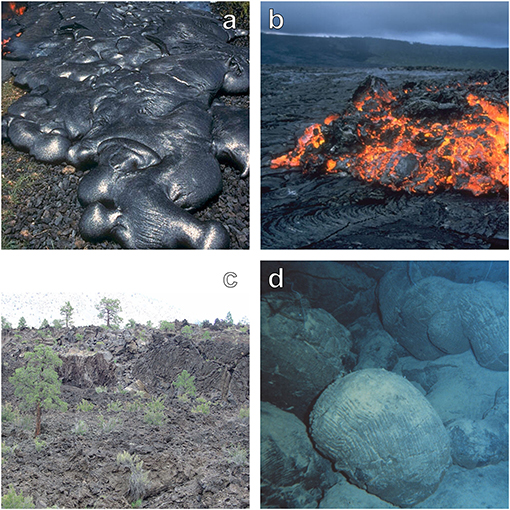
- Figure i - Four types of lava flows.
- (a) Pahoehoe lava catamenia, which is slow moving, on a shield volcano. (b) A'a lava flow, which is fast moving, on a shield volcano. (c) Blocky lava period, which is fast moving and high viscosity, on a stratovolcano. (d) Pillow lava catamenia on the sea floor. All photos are Public Domain.
Sometimes when lava flows on land, the outside layer of the flow cools and hardens offset while the inside layer continues to catamenia, insulated past the outer rock layer. The result is the formation of a lava tube (Effigy 2). Lava tubes unremarkably only form when the lava is depression viscosity and fast moving. As the lava supply to the tube runs out, the tube empties and the hardened exterior tunnel remains, leaving backside a long cave stretching from the base of the volcano, with smooth, flat floors like a hallway where the terminal of the lava flow hardened [iv].
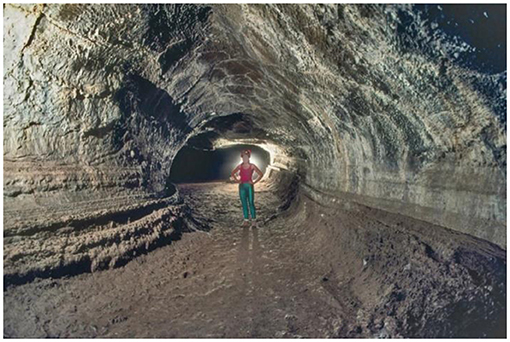
- Figure ii - A lava tube constitute in Valentine Cavern, Lava Beds National Monument, California, USA.
- [Photograph credit: Dave Bunnell/CC Past-SA two.5, confront of person in the photo blurred to protect privacy].
Studying lava flows is interesting because it allows volcanologists to meet how a landscape can be formed or dramatically inverse because of volcanic action. Underwater volcanoes play an important role in the formation of the body of water floor and new volcanic islands, while volcanoes on land are constantly forming and re-shaping the land effectually them.
Crystallization of Lava
Earlier magma leaves a volcano, it exists in one of three major forms, based on their chemic composition, viscosity, and temperature. They are all extremely hot and as well dangerous to measure upward close, so they are measured with thermal cameras instead [5]! The dissimilar types of magma make up one's mind what the cooled, solidified rock will look like. Some magma is very fluid and forms pahoehoe or a'a lava flows, which travel long distances. Other magma is more viscous and cooler, forming blocky lava flows. Magma can besides be highly viscous, relatively absurd, and class lava domes or blocky lava flows.
The blazon of magma, how long it takes to cool, and the gas present during a volcanic eruption bear upon what an igneous rock looks like after cooling and solidifying. Solidification of molten rock is chosen crystallization. Igneous rocks that cool underground cool more slowly, giving mineral crystals time to grow within the rock. In these rocks, the different minerals are large and piece of cake to see with the naked centre. Igneous rocks that crystallize at the earth'southward surface tend to cool much more quickly and have much smaller crystals. A volcanic rock made entirely of glass, called obsidian, forms from lava that cools with picayune to no crystals at all. If lava is flung into the air during an eruption, or if it comes in contact with water, the edges of the lava will also absurd to form a drinking glass.
When volcanoes violently erupt, many gas bubbles class in the lava, so it crystallizes into rocks filled with holes where the gas used to be. Rocks with holes formed from gas trapped in the lava are called vesicular rocks. Gases can sometimes be trapped in the rocks, assuasive volcanologists and geologists studying one-time vesicular rocks to determine which gases were present in aboriginal volcanoes [6]. Lava that contains very little gas tends to take no gas bubbles.
Types of Igneous Rocks
Volcanologists have names for all the various kinds of rocks that are formed from volcanic eruptions. These rocks are first classified into categories, including felsic, mafic, and intermediate, based on the types of minerals they contain (Figure 3). Basalt is the nigh common type of igneous stone made from lava. Basalt is a dark-colored rock in the mafic category, with very footling crystal formation. In contrast, andesite, an intermediate rock, is much lighter in colour and has many crystals visible without a magnifying glass. Granite is a type of non-volcanic igneous rock, formed from magma cooling slowly hole-and-corner. Granite is often used for kitchen or bathroom countertops and can be plant in a variety of colors, all sharing similar crystal size and mineral compositions.
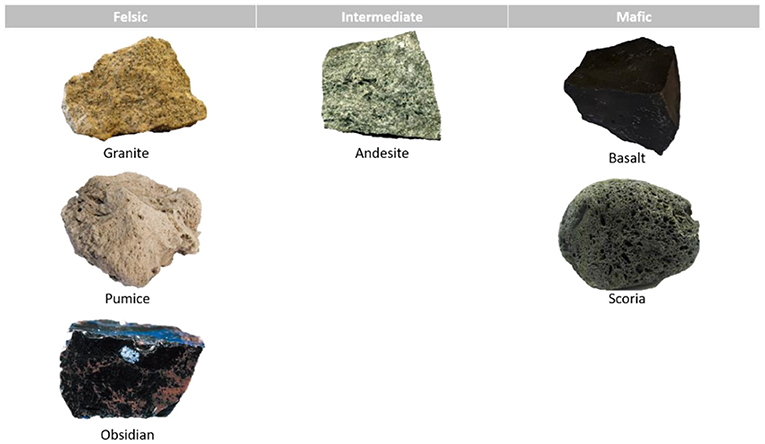
- Figure 3 - Examples of igneous rocks formed by volcanic eruptions.
- Felsic rocks are named for their loftier content of lite-colored minerals; mafic rocks contain much darker minerals; intermediate rocks take a more balanced blend of darker and lighter minerals. [Photo credits: Granite—Eurico Zimbres/CC BY-SA 2.0; Pumice—Benjamint444/CC BY-SA 3.0; Obsidian, Andesite—James St. John/CC BY 2.0; Basalt—Jan Nyssen/CC Past-SA 4.0; Scoria—Jonathan Zander/CC By-SA iii.0 Background removed from all photos].
Rocks without obvious crystals also vary a lot in colour and texture. Pumice is an example of a low-cal-colored, felsic, vesicular rock that can float in water. Scoria is also vesicular just is dark, mafic, and denser, unable to float in water. Obsidian, equanimous of volcanic glass, is a felsic rock that cooled with no crystals. Although obsidian appears to be dark, like basalt, information technology is felsic in limerick. Its dark appearance is due to impurities like atomic number 26 or magnesium present within the rock.
What Can Igneous Rocks Teach U.s.a.?
Many factors play a part in how rocks are created from volcanic eruptions, and what types and shapes of rocks volcanoes can produce. Volcanologists tin can expect at igneous rocks that formed from a volcano to empathise how it erupted, to study its geological history, and to predict future eruptions. Rock samples from multiple locations effectually a volcano tin exist dated to help construct an eruption history for the volcano. Using satellite imaging, geologic maps can be created to prove how each of the volcanic materials are distributed. Using this information, besides equally many other pieces of evidence, volcanologists can create a timeline of events for a volcanic region [seven]. Non every site will take simply one kind of igneous rock, and some sites may have had multiple volcanic eruptions, which makes this procedure extremely circuitous.
Using information from volcanoes to tell the story of earth'south geological past is fascinating, considering it may aid us to reply some primal questions. For example, did volcanic activity cause whatsoever of the known mass extinctions? If nosotros can find a specific surface area of the world with many volcanoes that erupted effectually the time of a known mass extinction event, we could have evidence to back up that the ii are linked [viii]. Volcanic eruptions spew big amounts of gases and ash into the temper, and both can affect climate. In particular, volcanic gases such as sulfur dioxide can trigger global cooling, whereas carbon dioxide tin contribute to global warming. The study of volcanic rocks is an interesting job, typically involving travel to locations of agile and dormant volcanoes around the world for the collection of data and samples of rocks to examine later in a lab. Such a career offers a fascinating glimpse into the history of our planet!
Glossary
Lava: ↑ Molten rock that has erupted at the Earth'due south surface.
Magma: ↑ Molten rock below or inside the World'due south crust.
Viscosity: ↑ Runny or sticky consistency; resistance to menstruum.
Lava Domes: ↑ A circular mound that results from the tedious eruption of pasty lava that piles upward around the vents of some volcanoes.
Crystallization: ↑ A procedure where molten (liquid or semi-liquid) rock hardens into solid rock.
Conflict of Interest
The authors declare that the research was conducted in the absence of whatsoever commercial or financial relationships that could be construed equally a potential conflict of interest.
Footnotes
1. ↑To read about volcano personalities, check out this commodity: Bachelor online at: https://kids.frontiersin.org/article/10.3389/frym.2018.00010/.
2. ↑To read more near the unlike types of volcanoes, see this webpage: Bachelor online at: https://openpress.usask.ca/physicalgeology//11-3-types-of-volcanoes/.
References
[one] ↑ Kiyosugi, K., Connor, C., Sparks, R. S. J., Crosweller, H. S., Brown, S. K., Siebert, L., et al. 2015. How many explosive eruptions are missing from the geologic record? Analysis of the quaternary record of large magnitude explosive eruptions in Japan. J. Appl. Volcanol. 4:17. doi: ten.1186/s13617-015-0035-9
[2] ↑ Zhang, J., Chen, J. 2017. Geophysical implications for the formation of the Tamu Massif – the World'due south largest single volcano – inside the Shatsky Rise in the northwest Pacific Ocean. Sci. Bull. 62:69–80. doi: 10.1016/j.scib.2016.11.003
[3] ↑ Wohletz, K., Heiken, 1000. 1992. Volcanology and Geothermal Free energy. Berkeley: University of California Press. p. 26-39. Available online at: http://ark.cdlib.org/ark:/13030/ft6v19p151/
[4] ↑ Piombo, A., Di Bari, M., Tallarico, A., Dragoni, M. 2016. Thermal bibelot at the Earth's surface associated with a lava tube. J. Volcanol. Geotherm. Res. 325:148–55. doi: 10.1016/j.jvolgeores.2016.06.019
[five] ↑ Patrick, One thousand. R., Orr, T., Antolik, Fifty., Lee, L., Kamibayashi, K. 2014. Continuous monitoring of Hawaiian volcanoes with thermal cameras. J. Appl. Volcanol. three:1. doi: ten.1186/2191-5040-3-1
[six] ↑ Xinhua, M., Guohui, L., Danlin, Y., Benjian, Z., Ya, L., Xin, D., et al. 2019. Distribution and gas-bearing properties of Permian igneous rocks in Sichuan Basin, SW China. Pet. Explor. Dev. 46:228–37. doi: ten.1016/S1876-3804(19)60004-two
[7] ↑ Guilbaud, 1000., Siebe, C., Layer, P., Salinas, S. 2012. Reconstruction of the volcanic history of the Tacámbaro-Puruarán area (Michoacán, México) reveals high frequency of Holocene monogenetic eruptions. Bull. Volcanol. 74:1187–211. doi: ten.1007/s00445-012-0594-0
[8] ↑ Davies JHFL, Marzoli, A., Bertrand, H., Youbi, North., Ernesto, M., Schaltegger, U. 2017. Stop-Triassic mass extinction started by intrusive Military camp activity. Nat. Commun. 8:15596. doi: 10.1038/ncomms15596
Source: https://kids.frontiersin.org/articles/10.3389/frym.2021.575178
0 Response to "1. what happens to hot lava after it erupts from a volcano?"
Post a Comment